An account of St. Munchin of Limerick from Fr. John Lanigan's Ecclesiastical History of Ireland, Vol III (1822), Chapt. xvii, p. 29 ff.
St. Manchan abbot of Meno-drochit (79) died in 652. (80) He was surnamed the wise and enjoyed a great reputation. (81) Some writers make him the same as Manchan abbot of Mohill in the now county of Leitrim (82) but there is reason to think that they were different persons. (83) Manchan the wise was I believe the same as the Manchan or as vulgarly called Munchin who is supposed to have been the first bishop of Limerick. For this supposition there is no sufficient authority (84) and as far as I can discover it rests on no other foundation than that Manchan the wise founded perhaps a monastery where Limerick now stands or that the first church in that place was dedicated in his name. Of the identity of Munchin of Limerick with Manchan the wise a stronger proof need not be required than that his festival is kept on the 2nd of January, the day assigned to the memory of Manchan the wise in all the Irish calendars. (85) There is not the least hint in any old document relative to our Church history of this Manchan having been raised to the episcopal rank but the veneration in which he was held at Limerick and the circumstance of its oldest church bearing his name gave rise at a late period to the opinion of his having been a bishop. Mistakes of this kind have occurred not only in Ireland but likewise in other countries.
(79) It is how called Mundrehid and is in the barony of Upper Ossory Queen's county The tract in which it lies was formerly called Disert chuillin. There was an abbot Lasren in this place who died AD 600. Tr. Th. p 376.
(80) Annals of Ulster and Usher p. 970 and Ind. Chron.
(81) The author of the work De Mirabilibus S. Scriputrae, of which hereafter, takes particular notice L. 2 c. 4 of the death of Manchan or as the present text has Manichaeus as one of the wise men of Ireland. He places it in the last year of the eleventh reckoning from the beginning of the world cycle of 532 years which according to his chronological principles was the same as AD 652 (See Usher p. 970). From the name Manichaeus Usher ib. seems to have concluded that Manachan's real name was the Hebrew Mendham which has been changed into Manichaeus. But Colgan maintains AA. SS. p. 332 that Manchan is a diminutive of the Irish Manach, a monk, and means a little monk. He observes that there were many persons in Ireland called Manchan, Manchen or Manchin and all names of the same import. Manichaeus is, as he justly remarks, probably a corruption of Manchanus and it will be seen that other Irish names have been corrupted in the text of that work. St. Manchan was in all probability the same as the holy and wise man named Manchen who is mentioned in the Life of St Mulua of Clonfert-molua as a survivor of his. See Usher p, 969.
(82) Usher seems to have been of this opinion. He had, see p. 969, a Life of St Manchan of Mohill said to have been written by Richard Fitz-Ralph, archbishop of Armagh, in which Manchan was called a Canon Regular of St Augustin and stated to have flourished in the year 608. But there were no such Canons regular in those times. He is there called also patron of seven churches. It is said that ever since said year glebes, lands, fiefs, tythes, &c. were granted to the estabtishmerit of Mohill. This account smells of a period much later than 608 for neither fiefs nor tythes were then known in Ireland. (Ware Antiq. cap. 26 at Leitrim makes him the same as Manchan of Mene-drochit and so does Archdall at Mohill as appears from his assigning his death to 652.
(83) In the Irish Calendars quoted by Colgan at 14 Febr. where he treats of Manchan of Mohill they are spoken of as destinct persons. Manchan the wise is mentioned at 2 January while the one of Mohill appears at 14 February. This is a strong proof that they were different although I will allow the only one for very little is known concerning these Manchans notwithstanding the great esteem in which the one surnamed Wise was held Colgan says that in want of authentic documents to prove the contrary he must consider them as different persons
(84) Ware Bishops at Limerick says that St Munchin son of Sedna was the first bishop of that city He does not refer to any authority nor had he any except a passage of a genealogical hagiology ap AA. SS. p 332 in which among five Manchans is reckoned Manchinus Lumnichensis fdius Sednae But this Manchin or Manchan is not called a bishop although a Manchan mentioned just before him is marked by that title I do not find either in the Irish calendars or annals any Manchan bishop of Limerick nor even one called of Limerick It is very probable that Manchan the wise was son of Sedna who is said to have been a descendant of Cormac Cas king of Munster and the founder of the Dalcassian line of princes As Thomond in which was comprized the country about Limerick was the patrimony of this race it is natural to suppose that Munchin son of Sedna was greatly revered in that territory of which he was probably a native And thus it can be easily accounted for why there was a church in Limerick called by his name without recurring to the unauthorized hypothesis of his having been bishop there Ware acknowledges that he was not able to find any account of Mun chin's successors at Limerick until about the beginning of the twelfth century and elsewhere Antiquities cap 29 at Limerick says that it is a very difficult point to ascertain who Munchin of Limerick was He mentions the opinion of those who make him the same as the Mancenus who according to Jocelin was left in Tirawley by St Patrick We have already seen Chap v 12 and ib Not 118 that this pretended Mancenus of St Patrick's times was no other than Manchan of Meno drochit But even if he were different and if there was a Manchan in Tyrawley at that early period how has it come to pass that neither in Joce line nor in the Tripartite is a word to be found about said Manchan having become bishop of Limerick although the latter work is particularly minute as to St Patrick's proceedings in the now county of Limerick The fact is that in St Patrick's days there was neither a town nor I dare say a village nor monastery in the place where Limerick is situated Ware touches also on the opinion that Munchin was the same as Munchan of Mene drochit which strange to think he supposed to be less probable than the other But he assigns no reason for his having thought so O Halloran pretends History fyc B vm ch 7 not only that Manchan was bishop of Limerick soon after the arrival of St Patrick in Ireland and that he had been employed in Connaught but likewise that before he became bishop he was abbot and the first of Muingharid Mungret near Limerick O Halloran confounded Mungret with Mene drochit notwithstanding their being most clearly distinguished by Colgan Harris &c &c The first abbot of Mungret at least on record was Nessan who died in 552 See Chap xi 6
(85) See A A SS p 333 In Ware's Antiquities cap 29 the first of January is mentioned by mistake for the festival of St Munchin instead of the second This mistake has not been corrected by Harris.
Showing posts with label History. Show all posts
Showing posts with label History. Show all posts
Tuesday, 26 March 2019
Saint Munchin of Limerick (Dublin University Magazine)
An account of St. Munchin of Limerick from the Dublin University Magazine, Vol. 28, (1846), p. 27:

Little is known of Limerick previous to the arrival of the Northmen except its being the site of a cathedral in the seventh century and it is to Ivan not Sitric we owe the first foundation of the city. St Munchin of the Dalcassian tribe was the first bishop but the old cathedral bearing his name is now no more a parish church of no very particular beauty supplying its place with associations of the archaism of its builder not the most impressive. The original edifice was beautifully situated overhanging the Shannon and the churchyard in which still repose the crumbling memorials of a little world once as busy as our own was bounded by the city wall John's castle and the chief of the seventeen gates of the town immediately adjoining. An old legend connected with the erection of this remnant of antiquity has survived the destructive hand of the modern architect known as Saint Munchin's prayer and as shadowing a truth of no little significance perhaps our friends of this part of the Shannon will thank us for its preservation.
In those very primitive times we are informed and how refreshing the intelligence it was no uncommon thing for the predecessors of our mitred lords to lay aside occasionally the crozier and crook for those humbler but not less useful implements the hammer and trowel St Munchin laying the foundation of his church in propria persona happened to require the assistance of one of our predatory friends already spoken of to raise a large stone but was refused. A stranger happening to pass proffered his aid when the saint exceeding wroth knelt down and abjured after no measured terms the conduct of the former praying that the efforts of a stranger in the city should ever prosper rather than those of one born within its walls.
Without alluding to the consanguinity of the wish of the saint and the thought according to the familiar formula of Wordsworth or whether the curse still continues in all its stringency perhaps there may be some other more philosophic mode of accounting for the matter. Bubbling up with kindliness and good nature we shall not entertain the problem. There are those in the world it cannot be denied who are ever anxious to build the sepulchres of the ancient prophets while the great minds of the present hour delving and digging in the common places of the world around are neglected and forgotten. Whether the legend has any covert allusion to such we shall not wait to examine.
[St. Munchin is among the Saints of Limerick on the excellent 'Omnium Sanctorum Hiberniae' blog.]
Little is known of Limerick previous to the arrival of the Northmen except its being the site of a cathedral in the seventh century and it is to Ivan not Sitric we owe the first foundation of the city. St Munchin of the Dalcassian tribe was the first bishop but the old cathedral bearing his name is now no more a parish church of no very particular beauty supplying its place with associations of the archaism of its builder not the most impressive. The original edifice was beautifully situated overhanging the Shannon and the churchyard in which still repose the crumbling memorials of a little world once as busy as our own was bounded by the city wall John's castle and the chief of the seventeen gates of the town immediately adjoining. An old legend connected with the erection of this remnant of antiquity has survived the destructive hand of the modern architect known as Saint Munchin's prayer and as shadowing a truth of no little significance perhaps our friends of this part of the Shannon will thank us for its preservation.
In those very primitive times we are informed and how refreshing the intelligence it was no uncommon thing for the predecessors of our mitred lords to lay aside occasionally the crozier and crook for those humbler but not less useful implements the hammer and trowel St Munchin laying the foundation of his church in propria persona happened to require the assistance of one of our predatory friends already spoken of to raise a large stone but was refused. A stranger happening to pass proffered his aid when the saint exceeding wroth knelt down and abjured after no measured terms the conduct of the former praying that the efforts of a stranger in the city should ever prosper rather than those of one born within its walls.
Without alluding to the consanguinity of the wish of the saint and the thought according to the familiar formula of Wordsworth or whether the curse still continues in all its stringency perhaps there may be some other more philosophic mode of accounting for the matter. Bubbling up with kindliness and good nature we shall not entertain the problem. There are those in the world it cannot be denied who are ever anxious to build the sepulchres of the ancient prophets while the great minds of the present hour delving and digging in the common places of the world around are neglected and forgotten. Whether the legend has any covert allusion to such we shall not wait to examine.
[St. Munchin is among the Saints of Limerick on the excellent 'Omnium Sanctorum Hiberniae' blog.]
Friday, 6 April 2018
Latin Mass Pilgrimage to Bansha, Co. Tipperary


Friday, 16 December 2016
Newcastle (Desmond) Castle
From Walsh's History of the Irish Hierarchy:

Newcastle in the barony of Conillo.
The knights Templar erected a castle in this place and adjacent thereto a town sprung up which was walled and became a corporation. In process of time it fell to decay and is now in ruins.
Newcastle in the barony of Conillo.
The knights Templar erected a castle in this place and adjacent thereto a town sprung up which was walled and became a corporation. In process of time it fell to decay and is now in ruins.
Wednesday, 28 September 2016
Ballinwillin Friary
From Walsh's History of the Irish Hierarchy:
Ballynwillin 'town of the mill' A house founded for Dominicans and of which there is no account except what the records of confiscation supply. It was granted with sixteen acres of land in Ballynwillin to the patentee of Ballynabrahir which see.
Ballynwillin 'town of the mill' A house founded for Dominicans and of which there is no account except what the records of confiscation supply. It was granted with sixteen acres of land in Ballynwillin to the patentee of Ballynabrahir which see.
Monday, 4 July 2016
Ballynagall Friary
From Fr. Thomas Walsh's History of the Irish Hierarchy:

Ballynegall 'town of the strangers' in the barony of Killmallock.
The family of Roche founded a monastery in this place for Dominican friars in the fourteenth century.
In the patent of Elizabeth and in the thirty ninth year of her reign it is expressly called a Carmelite friary. It was with a half carucate of land granted to the university of Dublin. Donoghe O'Dangane was the last prior, who was, in the reign of Philip and Mary, seized of the site of his monastery containing two acres and a church also a water mill and four acres of arable land with six in pasture in Ballynagall.
Ballynegall 'town of the strangers' in the barony of Killmallock.
The family of Roche founded a monastery in this place for Dominican friars in the fourteenth century.
In the patent of Elizabeth and in the thirty ninth year of her reign it is expressly called a Carmelite friary. It was with a half carucate of land granted to the university of Dublin. Donoghe O'Dangane was the last prior, who was, in the reign of Philip and Mary, seized of the site of his monastery containing two acres and a church also a water mill and four acres of arable land with six in pasture in Ballynagall.
Friday, 24 June 2016
Ardpatrick Abbey and Askeaton Friary
From Walsh's History of the Irish Hierarchy:

Ardpatrick an ancient abbey of which there is no historical account.
In the thirty second of Elizabeth, this abbey was found to be seized of the lands of Ballingowsee, Ballycowsynye, Ballnanyone and Bally gertayne, containing forty acres of the great measure annual value besides reprises 6s 8d.
In the thirty ninth of Elizabeth, it was found that the hill named Ardpatrick containing three acres of the large measure or twenty one of the small measure was in former times granted to the Corbeship or Termonland founded in the church of Ardpatrick that the said office of Corb or Erenach had continued by succession from time immemorial in the sept of the Langanes and that Maurice Langane was at that time the possessor.
There was a noble castle belonging to the FitzGeralds, earls of Desmond, situated on the river Askeaton in the barony of Conillo and on the river Deel formerly a walled town now a depopulated village. Many of the towns of Ireland owed their origin to the monasteries and since the destruction of those religious establishments those towns have gradually disappeared.
James the seventh earl of Desmond founded AD 1420 this monastery which adjoined the castle for conventual Franciscans. In 1490 it was reformed by the strict observants.
AD 1564 while persecution was raging in all its fury under Elizabeth, a provincial chapter of the order was held in the convent of Askeaton. It was soon after suppressed and in its ruins reminds the beholder of that tenacity with which the Irish Catholic has constantly adhered to the ancient faith and of the unavailing efforts of the persecutor to extinguish that creed.
Ardpatrick an ancient abbey of which there is no historical account.
In the thirty second of Elizabeth, this abbey was found to be seized of the lands of Ballingowsee, Ballycowsynye, Ballnanyone and Bally gertayne, containing forty acres of the great measure annual value besides reprises 6s 8d.
In the thirty ninth of Elizabeth, it was found that the hill named Ardpatrick containing three acres of the large measure or twenty one of the small measure was in former times granted to the Corbeship or Termonland founded in the church of Ardpatrick that the said office of Corb or Erenach had continued by succession from time immemorial in the sept of the Langanes and that Maurice Langane was at that time the possessor.
There was a noble castle belonging to the FitzGeralds, earls of Desmond, situated on the river Askeaton in the barony of Conillo and on the river Deel formerly a walled town now a depopulated village. Many of the towns of Ireland owed their origin to the monasteries and since the destruction of those religious establishments those towns have gradually disappeared.
James the seventh earl of Desmond founded AD 1420 this monastery which adjoined the castle for conventual Franciscans. In 1490 it was reformed by the strict observants.
AD 1564 while persecution was raging in all its fury under Elizabeth, a provincial chapter of the order was held in the convent of Askeaton. It was soon after suppressed and in its ruins reminds the beholder of that tenacity with which the Irish Catholic has constantly adhered to the ancient faith and of the unavailing efforts of the persecutor to extinguish that creed.
Wednesday, 4 May 2016
The See of Limerick (1400 - 1850)
From Chapter XXIV of 'History of the Irish Hierarchy' by Fr. Thomas Walsh:

Cornelius O'Dea, archdeacon of Killaloe, succeeded in 1400. Having presided twenty six years he resigned in order to lead a private life. He died on the 27th of July 1434 and was buried in his own cathedral under a monument of black marble adorned with his effigy.
John Motthel, an Augustin canon of Kells in the county of Kilkenny, succeeded in 1426 by provision of Pope Martin V and was the same year restored to the temporals. John governed the see almost thirty two years resigned in 1458 and died in the year of grace 1468.
William Creagh, a native of Limerick, succeeded in 1458 by provision of the Pope and was consecrated the year after. He sat about thirteen years and during his incumbency recovered the lands of Donaghmore which had been unjustly usurped by others. He died in 1472
Thomas Arthur, a native of the city of Limerick, succeeded in 1472 and died there in the year 1486.
Richard, appointed by Pope Innocent VIII died at Rome in 1486.
John Dunow, canon of Exeter, doctor of laws and then ambassador at Rome from King Henry VII, was appointed by the Pope in November 1486 and died there in the year 1488 before he had the opportunity of visiting his diocese.
John Folan, canon of Ferns, rector of Clonmore and procurator to Octavian, archbishop of Armagh at Rome, was promoted to the see of Limerick by the Pope on the 13th of May 1489. In the year following the citizens of Limerick repaired the nave of the cathedral of St. Mary's which was then fallen into great decay. The bishop John died on the 30th of January 1521.
John Coyn, or Quinn, a Dominican friar, was appointed by the Pope in 1522, who rejected Walter Wellesley the favorite candidate of King Henry VIII. John governed the see until April 1551 and then being blind and infirm resigned. John assisted at a synod held at Limerick AD 1524 by Edmond Butler archbishop of Cashel.
Hugh Lacy, canon of Limerick, was at the instance of Queen Mary advanced by the Pope to the see of Limerick in the year 1557 he resigned ie compelled to resign in 1571 and died in the year 1580. Hugh was grievously persecuted.
Mathew MacGrath died in 1623.
Richard Arthur presided in 1646.
Edmund O Dwyer succeeded. He attended the synod at Waterford and afterwards joined in the answer of the supreme council of the Catholics to the letter of the nuncio dissuading the peace with Lord Inchequin. Edmond died in exile in 1660.
James Dowley presided in 1687.
John Molony succeeded in 1688.
Cornelius O'Keeffe bishop in 1720, died in 1738.
Robert Lacy presiding in 1738, died in 1760.
Daniel Kearney in 1760 died in 1775.
Dionysius Conway in 1779 died 1796.
John Young in 1796 died 1813.
Charles Tuohy presided in 1815, died in 1828.
John Ryan, consecrated coadjutor in December 1825, succeeded in 1828. Still sits in the see of Limerick.
Cornelius O'Dea, archdeacon of Killaloe, succeeded in 1400. Having presided twenty six years he resigned in order to lead a private life. He died on the 27th of July 1434 and was buried in his own cathedral under a monument of black marble adorned with his effigy.
John Motthel, an Augustin canon of Kells in the county of Kilkenny, succeeded in 1426 by provision of Pope Martin V and was the same year restored to the temporals. John governed the see almost thirty two years resigned in 1458 and died in the year of grace 1468.
William Creagh, a native of Limerick, succeeded in 1458 by provision of the Pope and was consecrated the year after. He sat about thirteen years and during his incumbency recovered the lands of Donaghmore which had been unjustly usurped by others. He died in 1472
Thomas Arthur, a native of the city of Limerick, succeeded in 1472 and died there in the year 1486.
Richard, appointed by Pope Innocent VIII died at Rome in 1486.
John Dunow, canon of Exeter, doctor of laws and then ambassador at Rome from King Henry VII, was appointed by the Pope in November 1486 and died there in the year 1488 before he had the opportunity of visiting his diocese.
John Folan, canon of Ferns, rector of Clonmore and procurator to Octavian, archbishop of Armagh at Rome, was promoted to the see of Limerick by the Pope on the 13th of May 1489. In the year following the citizens of Limerick repaired the nave of the cathedral of St. Mary's which was then fallen into great decay. The bishop John died on the 30th of January 1521.
John Coyn, or Quinn, a Dominican friar, was appointed by the Pope in 1522, who rejected Walter Wellesley the favorite candidate of King Henry VIII. John governed the see until April 1551 and then being blind and infirm resigned. John assisted at a synod held at Limerick AD 1524 by Edmond Butler archbishop of Cashel.
Hugh Lacy, canon of Limerick, was at the instance of Queen Mary advanced by the Pope to the see of Limerick in the year 1557 he resigned ie compelled to resign in 1571 and died in the year 1580. Hugh was grievously persecuted.
Mathew MacGrath died in 1623.
Richard Arthur presided in 1646.
Edmund O Dwyer succeeded. He attended the synod at Waterford and afterwards joined in the answer of the supreme council of the Catholics to the letter of the nuncio dissuading the peace with Lord Inchequin. Edmond died in exile in 1660.
James Dowley presided in 1687.
John Molony succeeded in 1688.
Cornelius O'Keeffe bishop in 1720, died in 1738.
Robert Lacy presiding in 1738, died in 1760.
Daniel Kearney in 1760 died in 1775.
Dionysius Conway in 1779 died 1796.
John Young in 1796 died 1813.
Charles Tuohy presided in 1815, died in 1828.
John Ryan, consecrated coadjutor in December 1825, succeeded in 1828. Still sits in the see of Limerick.
Thursday, 7 April 2016
The See of Limerick (1207 - 1400)
From Chapter XXIV of 'History of the Irish Hierarchy' by Fr. Thomas Walsh:

Geoffry bishop of Limerick sat in 1217.
Edmund bishop of Limerick died in 1222.
Hubert de Burgo a prelate descended of a noble family and prior of the monastery of Athassel in the county of Tipperary succeeded in 1222 and obtained the temporals in that year. He was a liberal benefactor to the cathedral to the canons and vicars choral of it. A little before the death of this prelate the bishops of Ireland had formed a project to deprive the king of the custody of the temporalities of sees while vacant and also to obstruct their tenants from suing in the king's courts without the Pope's assent. Hubert de Burgo was selected by the Irish bishops to arrange this affair at Rome. This attempt alarmed the king who instructed his agents at the court of Rome to resist and oppose any such effort with all their might. The death of de Burgo in 1250 prevented his journey and put an end to the design of the prelates.
Robert of Emly was elected by the dean and chapter in the year 1251. In the year 1253, Robert granted to Thomas of Woodford, dean of Limerick, and to his successors, the benefices of Carnarthy and Rathsiward. Robert died on the 8th of September 1272.
Gerald de Mareschall, archdeacon of Limerick, succeeded in 1272 and was consecrated by the archbishop of Cashel. He obtained the temporals the king reserving for one year to himself knight's fees advowsons wards reliefs and escheats. Robert recovered a great many possessions of his see which others had unjustly usurped. In 1297, he obtained judgment against Richard Myath for one messuage one plow land and four hundred acres of wood with their appurtenances in the lands of Lisredy which his predecessor Robert had granted to said Richard without the consent of the chapter of Limerick. He governed this see twenty nine years and died on the 10th of February 1301. The constitutions of this prelate are extant in the registry of the bishops of Limerick.
Robert of Dondonyl, canon of the cathedral of Limerick, succeeded by election of the chapter and was consecrated in 1302. He obtained the temporals in the September of that year. He sat almost nine years and was buried in his own church.
Eustace del Ewe, or Waters, dean of Limerick, was consecrated before the close of the year 1311. He expended large sums of money in adorning and repairing his church and, having finished it, dedicated his cathedral in July 1327. He died on the 3d of May 1336 having enjoyed the see upwards of twenty four years and was buried in his own church.
Maurice Rochfort, or de Rupe, was consecrated at Limerick on the 6th of April 1337. An information was exhibited against him for preventing the subsidy from being levied which the parliament granted to the king. He was some time deputy to Sir Thomas Rokeby, justice of Ireland. He died on the 9th of June or in April 1353. The annals of Nenagh style him a man of a good life and honest conversation.
Stephen Lawless, chancellor of the cathedral of Limerick, succeeded in 1354 and obtained the temporals from the king Stephen died on the feast of the holy Innocents 1359.
Stephen de Valle, or Wall, dean of Limerick, succeeded in 1360 by provision of the Pope. He presided nine years and was treasurer of Ireland. Was translated to the see of Meath where he sat ten years and having died at Oxford in November 1379 was buried there in a monastery of Dominicans. While he was bishop of Limerick he translated the bones of Richard Fitz Ralph, archbishop of Armagh, commonly called Saint Richard of Dundalk, from Avignon to Dundalk, the birth place of that archbishop, and deposited them in a monument in the parish church of St Nicholas in that town. In a parliament held at Trim in June 1485 a chantry was confirmed in this church of St Nicholas at Dundalk in honor of God the blessed Virgin St. Nicholas and St. Richard of Dundalk. The virtues of FitzRalph, archbishop of Armagh, were so great and the miracles ascribed to him were so many that Pope Boniface IX issued a bull to John Cotton, archbishop of Armagh, Richard Young, bishop elect of Bangor, and to the abbot of Osney near Oxford, to hold an enquiry concerning the truth of those miracles. The result of the commission vanished in silence. On account of his opposition to the Regulars some have treated him and his writings with indifference. Bellarmine thinks his writings ought to be read with caution, others allowing him to have been a man of great accomplishments, rank him among the heretics, but the celebrated Luke Wadding, though not inclined to favor him, vindicates him of such a foul aspersion and adds that Ralph never departed from the unity of the church having submitted all his writings to her correction and decision.
Peter Curragh, or Creath, a native of the county of Dublin, was elected in 1369 and having sworn fealty to King Edward III obtained the temporals. In Luke Wadding's works is recorded a bull of Pope Gregory XI dated at Avignon the 20th of August 1376 in which are enumerated the charges against Peter, bishop of Limerick, by the archbishop of Cashel who was conservator of the privileges of the Franciscan friars in Ireland. The whole matter was referred to Simon Sudbury, archbishop of Canterbury, who was armed with authority to enquire into the proceedings of this bishop and should the complaints be found true, which Philip de Torrington, the metropolitan of Cashel advanced to pronounce, the bishop and his accomplices excommunicated.
The charges against the bishop of Limerick were that when archbishop Torrington came to redress the grievances of the Franciscans and cited the bishop to answer their complaints, he laid violent hands on the archbishop tore the citation from him with such violence and force that he drew his blood and like a man bereft of his senses ordered the archbishop to begone or it should fare worse with him and his attendants, that the bishop being cited refused to appear by himself or proctor laid more grievances on the friars after the citation than before and excommunicated all within his diocese who should repair for divine service or burial within their church, that the bishop having been a long time excommunicated for debts due to the apostolic see paid no regard thereto but acted as usual, that the archbishop having cited him for heresy he was together with the clergy who attended him in danger of being assaulted if he had not retired, and that after his retiring the bishop clad in his pontificals entered the city of Limerick with his accomplices and by bell book and candle publicly excommunicated every person who had supplied the archbishop with food or entertainment, that when he the archbishop had on a day of solemnity repaired to Limerick according to custom to preach the bishop caused public proclamation to be made that nobody under pain of excommunication should hear the archbishop's sermon and excommunicated by name all those who attended it that when he had left the city the bishop sent some of his servants after him who laid violent hands on him and forced the bridle of his horse. How this affair terminated is not on record Peter bishop of Limerick resigned in the year 1400 and died 1407.
Geoffry bishop of Limerick sat in 1217.
Edmund bishop of Limerick died in 1222.
Hubert de Burgo a prelate descended of a noble family and prior of the monastery of Athassel in the county of Tipperary succeeded in 1222 and obtained the temporals in that year. He was a liberal benefactor to the cathedral to the canons and vicars choral of it. A little before the death of this prelate the bishops of Ireland had formed a project to deprive the king of the custody of the temporalities of sees while vacant and also to obstruct their tenants from suing in the king's courts without the Pope's assent. Hubert de Burgo was selected by the Irish bishops to arrange this affair at Rome. This attempt alarmed the king who instructed his agents at the court of Rome to resist and oppose any such effort with all their might. The death of de Burgo in 1250 prevented his journey and put an end to the design of the prelates.
Robert of Emly was elected by the dean and chapter in the year 1251. In the year 1253, Robert granted to Thomas of Woodford, dean of Limerick, and to his successors, the benefices of Carnarthy and Rathsiward. Robert died on the 8th of September 1272.
Gerald de Mareschall, archdeacon of Limerick, succeeded in 1272 and was consecrated by the archbishop of Cashel. He obtained the temporals the king reserving for one year to himself knight's fees advowsons wards reliefs and escheats. Robert recovered a great many possessions of his see which others had unjustly usurped. In 1297, he obtained judgment against Richard Myath for one messuage one plow land and four hundred acres of wood with their appurtenances in the lands of Lisredy which his predecessor Robert had granted to said Richard without the consent of the chapter of Limerick. He governed this see twenty nine years and died on the 10th of February 1301. The constitutions of this prelate are extant in the registry of the bishops of Limerick.
Robert of Dondonyl, canon of the cathedral of Limerick, succeeded by election of the chapter and was consecrated in 1302. He obtained the temporals in the September of that year. He sat almost nine years and was buried in his own church.
Eustace del Ewe, or Waters, dean of Limerick, was consecrated before the close of the year 1311. He expended large sums of money in adorning and repairing his church and, having finished it, dedicated his cathedral in July 1327. He died on the 3d of May 1336 having enjoyed the see upwards of twenty four years and was buried in his own church.
Maurice Rochfort, or de Rupe, was consecrated at Limerick on the 6th of April 1337. An information was exhibited against him for preventing the subsidy from being levied which the parliament granted to the king. He was some time deputy to Sir Thomas Rokeby, justice of Ireland. He died on the 9th of June or in April 1353. The annals of Nenagh style him a man of a good life and honest conversation.
Stephen Lawless, chancellor of the cathedral of Limerick, succeeded in 1354 and obtained the temporals from the king Stephen died on the feast of the holy Innocents 1359.
Stephen de Valle, or Wall, dean of Limerick, succeeded in 1360 by provision of the Pope. He presided nine years and was treasurer of Ireland. Was translated to the see of Meath where he sat ten years and having died at Oxford in November 1379 was buried there in a monastery of Dominicans. While he was bishop of Limerick he translated the bones of Richard Fitz Ralph, archbishop of Armagh, commonly called Saint Richard of Dundalk, from Avignon to Dundalk, the birth place of that archbishop, and deposited them in a monument in the parish church of St Nicholas in that town. In a parliament held at Trim in June 1485 a chantry was confirmed in this church of St Nicholas at Dundalk in honor of God the blessed Virgin St. Nicholas and St. Richard of Dundalk. The virtues of FitzRalph, archbishop of Armagh, were so great and the miracles ascribed to him were so many that Pope Boniface IX issued a bull to John Cotton, archbishop of Armagh, Richard Young, bishop elect of Bangor, and to the abbot of Osney near Oxford, to hold an enquiry concerning the truth of those miracles. The result of the commission vanished in silence. On account of his opposition to the Regulars some have treated him and his writings with indifference. Bellarmine thinks his writings ought to be read with caution, others allowing him to have been a man of great accomplishments, rank him among the heretics, but the celebrated Luke Wadding, though not inclined to favor him, vindicates him of such a foul aspersion and adds that Ralph never departed from the unity of the church having submitted all his writings to her correction and decision.
Peter Curragh, or Creath, a native of the county of Dublin, was elected in 1369 and having sworn fealty to King Edward III obtained the temporals. In Luke Wadding's works is recorded a bull of Pope Gregory XI dated at Avignon the 20th of August 1376 in which are enumerated the charges against Peter, bishop of Limerick, by the archbishop of Cashel who was conservator of the privileges of the Franciscan friars in Ireland. The whole matter was referred to Simon Sudbury, archbishop of Canterbury, who was armed with authority to enquire into the proceedings of this bishop and should the complaints be found true, which Philip de Torrington, the metropolitan of Cashel advanced to pronounce, the bishop and his accomplices excommunicated.
The charges against the bishop of Limerick were that when archbishop Torrington came to redress the grievances of the Franciscans and cited the bishop to answer their complaints, he laid violent hands on the archbishop tore the citation from him with such violence and force that he drew his blood and like a man bereft of his senses ordered the archbishop to begone or it should fare worse with him and his attendants, that the bishop being cited refused to appear by himself or proctor laid more grievances on the friars after the citation than before and excommunicated all within his diocese who should repair for divine service or burial within their church, that the bishop having been a long time excommunicated for debts due to the apostolic see paid no regard thereto but acted as usual, that the archbishop having cited him for heresy he was together with the clergy who attended him in danger of being assaulted if he had not retired, and that after his retiring the bishop clad in his pontificals entered the city of Limerick with his accomplices and by bell book and candle publicly excommunicated every person who had supplied the archbishop with food or entertainment, that when he the archbishop had on a day of solemnity repaired to Limerick according to custom to preach the bishop caused public proclamation to be made that nobody under pain of excommunication should hear the archbishop's sermon and excommunicated by name all those who attended it that when he had left the city the bishop sent some of his servants after him who laid violent hands on him and forced the bridle of his horse. How this affair terminated is not on record Peter bishop of Limerick resigned in the year 1400 and died 1407.
Wednesday, 2 March 2016
The See of Limerick (-1207)
From Chapter XXIV of 'History of the Irish Hierarchy' by Fr. Thomas Walsh:

Was founded in the twelfth century Some attribute its foundation to Saint Munchin, the son of Sedna, but there is no certainty that he was bishop.
Ferrar in his history of Limerick could not find anything authentic until the middle of the ninth century nor could Ware or Harris discover any undoubted bishop of Limerick until Gilbert who flourished in the eleventh.
Though the Danes of Limerick had been converted to the Christian faith in the early part of the eleventh century still they did not enjoy the benefit of a resident prelate until Gilbert was unanimously chosen by clergy and people in the year 1106.
This prelate had been abbot of Bangor and probably had been consecrated before his election to Limerick was an Irishman though some assert that he was a Dane for it so appears evident from the correspondence which occurred between him and St. Anselm with whom he became acquainted in his travels on the Continent.
While Gilbert presided he exerted himself in establishing an uniform system in the liturgical practices of Ireland and for this purpose composed a treasise De usu Ecclesiastico. In this tract he assures the prelates and clergy of the Irish church that in compliance with the wishes of many of their brethren he has endeavored to point out the canonical system of saying the hours of the divine office and performing the duties of the ecclesiastical order.
Gilbert wrote another tract in which he arranges the different gradations of the highest ecclesiastical dignitaries to the humblest official of the order assigning to each their respective powers and duties Gilbert was also legate apostolic an office which he resigned in 1139 and died the year following.
Donald O Brien, king of Limerick, founded and endowed the Cathedral of Limerick and dedicated it to the Virgin Mary. In the 13th century Donatus O Brien bishop of Limerick became a great benefactor factor to this cathedral he assigned prebends to the dean and chapter and made some constitutions concerning the liturgy used in his church and the privileges of his canons. About the year 1490 the citizens of Limerick rebuilt the nave of the cathedral which had fallen to ruin.
In the twelfth century the see of Inniscathy was united to that of Limerick on the death of Aid O'Beachain, the last bishop of that see.
Gillbert, bishop of Limerick and apostolic legate of Ireland died in 1140. St. Malachy O'Moore of Armagh was appointed legate in his stead.
Patrick, bishop of Limerick succeeded in 1140 and through the influence of the Danes was sent to England where he was consecrated by Theobald, archbishop of Canterbury, to whom Patrick made the following profession of obedience: "I Patrick, elected to the government of the church of Limerick and now through the grace of God to be consecrated by thee most Rev. Father Theobald, archbishop of the holy church of Canterbury, and primate of all Britain, do promise that I will pay due subjection and canonical obedience to thee and to all thy successors who shall succeed thee canonically."
Patrick was the only bishop of Limerick and the last of the Irish prelates who made a profession of obedience to the see of Canterbury. Patrick presided but a short time.
Harold a Dane succeeded. Died in 1151.
Turgese, a Dane or Ostman sat in 1152, assisted at the council of Kells held in that year by Cardinal Paparo.
Brictius, who was also a Dane, succeeded. He was one of the Irish prelates who assisted at the council of Lateran in the years 1179 and 1180. Donald O'Brien, king of Limerick, granted the lands of Mungret and those of Ivamnach to this prelate and his successors and to the clergy of St Mary's, Limerick.
Donatus O'Brien descended of the royal family of the name succeeded about the close of the twelfth century. Illustrious by birth but more so by his learning wisdom and liberality, Donat enlarged the cathedral and supplied it with secular canons to whom he assigned prebends and laid down rules for their guidance. This prelate died in the year 1207.
SEE OF LIMERICK
Was founded in the twelfth century Some attribute its foundation to Saint Munchin, the son of Sedna, but there is no certainty that he was bishop.
Ferrar in his history of Limerick could not find anything authentic until the middle of the ninth century nor could Ware or Harris discover any undoubted bishop of Limerick until Gilbert who flourished in the eleventh.
Though the Danes of Limerick had been converted to the Christian faith in the early part of the eleventh century still they did not enjoy the benefit of a resident prelate until Gilbert was unanimously chosen by clergy and people in the year 1106.
This prelate had been abbot of Bangor and probably had been consecrated before his election to Limerick was an Irishman though some assert that he was a Dane for it so appears evident from the correspondence which occurred between him and St. Anselm with whom he became acquainted in his travels on the Continent.
While Gilbert presided he exerted himself in establishing an uniform system in the liturgical practices of Ireland and for this purpose composed a treasise De usu Ecclesiastico. In this tract he assures the prelates and clergy of the Irish church that in compliance with the wishes of many of their brethren he has endeavored to point out the canonical system of saying the hours of the divine office and performing the duties of the ecclesiastical order.
Gilbert wrote another tract in which he arranges the different gradations of the highest ecclesiastical dignitaries to the humblest official of the order assigning to each their respective powers and duties Gilbert was also legate apostolic an office which he resigned in 1139 and died the year following.
Donald O Brien, king of Limerick, founded and endowed the Cathedral of Limerick and dedicated it to the Virgin Mary. In the 13th century Donatus O Brien bishop of Limerick became a great benefactor factor to this cathedral he assigned prebends to the dean and chapter and made some constitutions concerning the liturgy used in his church and the privileges of his canons. About the year 1490 the citizens of Limerick rebuilt the nave of the cathedral which had fallen to ruin.
In the twelfth century the see of Inniscathy was united to that of Limerick on the death of Aid O'Beachain, the last bishop of that see.
Gillbert, bishop of Limerick and apostolic legate of Ireland died in 1140. St. Malachy O'Moore of Armagh was appointed legate in his stead.
Patrick, bishop of Limerick succeeded in 1140 and through the influence of the Danes was sent to England where he was consecrated by Theobald, archbishop of Canterbury, to whom Patrick made the following profession of obedience: "I Patrick, elected to the government of the church of Limerick and now through the grace of God to be consecrated by thee most Rev. Father Theobald, archbishop of the holy church of Canterbury, and primate of all Britain, do promise that I will pay due subjection and canonical obedience to thee and to all thy successors who shall succeed thee canonically."
Patrick was the only bishop of Limerick and the last of the Irish prelates who made a profession of obedience to the see of Canterbury. Patrick presided but a short time.
Harold a Dane succeeded. Died in 1151.
Turgese, a Dane or Ostman sat in 1152, assisted at the council of Kells held in that year by Cardinal Paparo.
Brictius, who was also a Dane, succeeded. He was one of the Irish prelates who assisted at the council of Lateran in the years 1179 and 1180. Donald O'Brien, king of Limerick, granted the lands of Mungret and those of Ivamnach to this prelate and his successors and to the clergy of St Mary's, Limerick.
Donatus O'Brien descended of the royal family of the name succeeded about the close of the twelfth century. Illustrious by birth but more so by his learning wisdom and liberality, Donat enlarged the cathedral and supplied it with secular canons to whom he assigned prebends and laid down rules for their guidance. This prelate died in the year 1207.
Tuesday, 2 February 2016
Abington Abbey
From Walsh's History of the Irish Hierarchy:

Abbingdon Wotheny
This abbey was founded AD 1205 for Cistercian monks by Theobald FitzWalter, lord of Carrick and chief butler of Ireland, who richly endowed it and having died was interred here in 1206. It was supplied with monks from the abbey of Savigniac in France
AD 1228 William was abbot
AD 1290 the abbot having harbored the king's enemies was fined in the sum of sixty marcs
AD 1307 It appears the abbot of Abbingdon paid to the convent of Kells in Ossory the sum of 100s
John O'Mulryan was the last abbot. At the suppression of monasteries eleven rectories and fifteen townlands in the counties of Limerick and Kerry were granted at an annual rent of 57 2s 3d to Peter Walsh for ever in capite and who was by compact bound to maintain one horseman on the premises. April 1st, eighteenth of King James, Sir Edward Walsh, knight, was found to be seized of its possessions. In Spelman's history of sacrilege it is related that this family have gone to desolation.
Abbingdon Wotheny
This abbey was founded AD 1205 for Cistercian monks by Theobald FitzWalter, lord of Carrick and chief butler of Ireland, who richly endowed it and having died was interred here in 1206. It was supplied with monks from the abbey of Savigniac in France
AD 1228 William was abbot
AD 1290 the abbot having harbored the king's enemies was fined in the sum of sixty marcs
AD 1307 It appears the abbot of Abbingdon paid to the convent of Kells in Ossory the sum of 100s
John O'Mulryan was the last abbot. At the suppression of monasteries eleven rectories and fifteen townlands in the counties of Limerick and Kerry were granted at an annual rent of 57 2s 3d to Peter Walsh for ever in capite and who was by compact bound to maintain one horseman on the premises. April 1st, eighteenth of King James, Sir Edward Walsh, knight, was found to be seized of its possessions. In Spelman's history of sacrilege it is related that this family have gone to desolation.
Tuesday, 5 January 2016
The Religious Houses of Adare
From Walsh's History of the Irish Hierarchy:
Adaire formerly a place of note in the barony of Kennery.

Trinitarian Friary This house was founded for the order of the holy and undivided Trinity for the redemption of captives in the reign of king Edward I by John earl of Kildare.
November 4th, thirty seventh of Elizabeth, this abbey with all its possessions was granted to Sir Henry Wallop knight for ever by fealty only in free and common soccage at the annual rent of 26 17s 8d Irish money, Sir Henry engaging to maintain two horsemen on the premises mises and that no part whatever of the same should he alienated to the Irish.
From the invasion of Ireland by Henry II to the close of Elizabeth's reign, almost a period of four hundred years, the insidious policy of England has exhibited, because it has engendered them, the most tragic scenes of infatuated misrule, on the one side, and of insubordination necessarily arising from oppression and of resistance, sanguinary but unsuccessful, on the other, ever since that fatal period the history of Ireland, is that of physical or moral opposition, as circumstances dictated, to the leaders of Ireland and during this melancholy period the actuating principle which guided the rulers of England in their schemes of devastation and horror, a principle which according to even Protestant writers originated, with the false and insidious Cambrensis, whose mode of civilizing the Irish was to exterminate them and seize their estates seems to have been inherited by their successors of the present day who have manifestly improved on the system of their predecessors adding thereto all that infuriate malice and bigotry of which the government of England, as well as her people are so susceptible, when a consciousness of her strength can dictate aggression on the rights as well as the religion of the Irish people.
Some large and perfect ruins of this abbey still remain. The steeple resembles a castle and is supported by a plain arch with four diagonal ogives meeting in the centre and stairs leading to the battlements.
Augustinian friary situated on the south side of the river Mague was founded by John earl of Kildare, son to earl Thomas, who died AD 1315. King Edward II confirmed the grants of the founder AD 1317. This friary with its possessions was granted to Sir Henry Wallop, knight, on the terms of the former grant of the Trinitarian property. A great part of this friary still remains in good preservation. The steeple similar to the former is supported on an arch the choir is large with stalls and the nave answerable thereto with a lateral aisle on the south side. To the north of the steeple are some beautiful cloisters with pointed windows within which on three sides of the square are corridors and on most of the windows are escutcheons with English crosses ranged alternately with saltire ones. The workmanship is simply elegant the principal parts being of hewn stone which appear so fresh as to give it a modern yet venerable appearance. Adjoining the cloisters were several apartments which seem to be more ancient than the other parts of the building.

Gray friary was founded in the year 1465 by Thomas earl of Kildare and his wife Joanna at their sole expense and was consecrated the following year the founders presenting it with two silver chalices and a bell. No vestiges of this building remained in 1781 except a lofty square steeple. This abbey and its possessions were granted to Sir Henry Wallop, knight.
Adaire formerly a place of note in the barony of Kennery.
Trinitarian Friary This house was founded for the order of the holy and undivided Trinity for the redemption of captives in the reign of king Edward I by John earl of Kildare.
November 4th, thirty seventh of Elizabeth, this abbey with all its possessions was granted to Sir Henry Wallop knight for ever by fealty only in free and common soccage at the annual rent of 26 17s 8d Irish money, Sir Henry engaging to maintain two horsemen on the premises mises and that no part whatever of the same should he alienated to the Irish.
From the invasion of Ireland by Henry II to the close of Elizabeth's reign, almost a period of four hundred years, the insidious policy of England has exhibited, because it has engendered them, the most tragic scenes of infatuated misrule, on the one side, and of insubordination necessarily arising from oppression and of resistance, sanguinary but unsuccessful, on the other, ever since that fatal period the history of Ireland, is that of physical or moral opposition, as circumstances dictated, to the leaders of Ireland and during this melancholy period the actuating principle which guided the rulers of England in their schemes of devastation and horror, a principle which according to even Protestant writers originated, with the false and insidious Cambrensis, whose mode of civilizing the Irish was to exterminate them and seize their estates seems to have been inherited by their successors of the present day who have manifestly improved on the system of their predecessors adding thereto all that infuriate malice and bigotry of which the government of England, as well as her people are so susceptible, when a consciousness of her strength can dictate aggression on the rights as well as the religion of the Irish people.
Some large and perfect ruins of this abbey still remain. The steeple resembles a castle and is supported by a plain arch with four diagonal ogives meeting in the centre and stairs leading to the battlements.
Augustinian friary situated on the south side of the river Mague was founded by John earl of Kildare, son to earl Thomas, who died AD 1315. King Edward II confirmed the grants of the founder AD 1317. This friary with its possessions was granted to Sir Henry Wallop, knight, on the terms of the former grant of the Trinitarian property. A great part of this friary still remains in good preservation. The steeple similar to the former is supported on an arch the choir is large with stalls and the nave answerable thereto with a lateral aisle on the south side. To the north of the steeple are some beautiful cloisters with pointed windows within which on three sides of the square are corridors and on most of the windows are escutcheons with English crosses ranged alternately with saltire ones. The workmanship is simply elegant the principal parts being of hewn stone which appear so fresh as to give it a modern yet venerable appearance. Adjoining the cloisters were several apartments which seem to be more ancient than the other parts of the building.
Gray friary was founded in the year 1465 by Thomas earl of Kildare and his wife Joanna at their sole expense and was consecrated the following year the founders presenting it with two silver chalices and a bell. No vestiges of this building remained in 1781 except a lofty square steeple. This abbey and its possessions were granted to Sir Henry Wallop, knight.
Wednesday, 2 December 2015
Town of the Friars
Ballynabrahir 'town of the friars' in the barony of Small County. The family of Clangibbon founded this monastery for conventual Franciscans in the thirteenth century,
February 4th, thirty fifth of Henry VIII, this friary with three acres and a stang of arable land was granted for ever to Robert Browne at the yearly rent of 12d Irish money. James Gould died in the year 1600 seized of this priory and of one carucate of land in free and common soccage.
February 4th, thirty fifth of Henry VIII, this friary with three acres and a stang of arable land was granted for ever to Robert Browne at the yearly rent of 12d Irish money. James Gould died in the year 1600 seized of this priory and of one carucate of land in free and common soccage.
Wednesday, 4 November 2015
Mungret Abbey
From Fr. Walsh's History of the Irish Hierarchy:

St. Nessan, who died AD 552, was the disciple of St. Ailbe of Emly. Nessan was most probably the founder of Mungret monastery. He never attained in the church a higher dignity than that of deacon by which title he is constantly known, yet his reputation is so great that he is reckoned among the fathers of the Irish church. His festival was celebrated at Mungret on the 25th of July.
The monastery of the island called Ireland's Eye in the county of Dublin is said to have been founded by a St. Nessan. That isle originally called Inis faithlen obtained the name of Inis Mac Nessan from the sons of Nessan, who were revered there on the 15th of March. Their names are Dichull Munissa and Neslug.
A.D. 552 died the abbot St. Nessan. St. Manchin, called the first bishop of Limerick, is said to have been abbot of Mungret.
A.D. 760 died the abbot Ailill.
A.D. 820 and 834 the Danes devastated the abbey of Mungret.
A.D. 1102 the 5th of October, the blessed Mugron O'Moore, principal professor of divinity at Armagh and in all the west of Europe, died in this abbey.
A.D. 1107 this abbey was again sacked. The psalter of Cashel relates that this establishment had at one period six churches within its walls and contained, exclusively of scholars, 1500 religious, 500 of whom were learned preachers, 500 were psalmists, and the remaining 500 applied themselves to contemplation, works of charity, and other spiritual exercises.
St. Nessan, who died AD 552, was the disciple of St. Ailbe of Emly. Nessan was most probably the founder of Mungret monastery. He never attained in the church a higher dignity than that of deacon by which title he is constantly known, yet his reputation is so great that he is reckoned among the fathers of the Irish church. His festival was celebrated at Mungret on the 25th of July.
The monastery of the island called Ireland's Eye in the county of Dublin is said to have been founded by a St. Nessan. That isle originally called Inis faithlen obtained the name of Inis Mac Nessan from the sons of Nessan, who were revered there on the 15th of March. Their names are Dichull Munissa and Neslug.
A.D. 552 died the abbot St. Nessan. St. Manchin, called the first bishop of Limerick, is said to have been abbot of Mungret.
A.D. 760 died the abbot Ailill.
A.D. 820 and 834 the Danes devastated the abbey of Mungret.
A.D. 1102 the 5th of October, the blessed Mugron O'Moore, principal professor of divinity at Armagh and in all the west of Europe, died in this abbey.
A.D. 1107 this abbey was again sacked. The psalter of Cashel relates that this establishment had at one period six churches within its walls and contained, exclusively of scholars, 1500 religious, 500 of whom were learned preachers, 500 were psalmists, and the remaining 500 applied themselves to contemplation, works of charity, and other spiritual exercises.
Tuesday, 15 September 2015

Wednesday, 9 September 2015
National Latin Mass Pilgrimage to Knock 2015
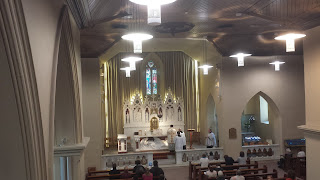
The National Latin Mass Pilgrimage is a special event in Knock. Unique among Latin Mass pilgrimages around the Country, His Grace, the Archbishop of Tuam has designated this pilgrimage under his own authority and appointed a chaplain, Fr. John Loftus of the Diocese of Killala.
The organisation of the National Pilgrimage was undertaken by Our Lady's Catholic Heritage Association in co-ordination with the other Catholic Heritage Associations around the Country but all Latin Mass Communities, Chaplaincies, Associations and groups around the Country are invited to participate each year.
As usual, the main exercises of the pilgrimage took place in the old Parish Church of Knock, whish stood when the apparitions took place. The apparitions are uniquely Eucharistic in that the Blessed Sacrament was present in the form of the Lamb of God with Our Lady, St. Joseph and St. John, during the whole of the apparition. That may be the reason for the silence of the apparition and perhaps the key to it's central message, the importance of silence in the presence of the Blessed Sacrament - very appropriate for the Traditional Latin Mass.
There was a tremendous turn out from all parts of the Country for a Missa Cantata of Our Lady celebrated by Fr. Loftus. In keeping with the exercises of the official pilgrimages to the Shrine, the Missa Cantata was followed by the Stations of the Cross and the pilgrimage concluded with Benediction of the Blessed Sacrament.




The organisation of the National Pilgrimage was undertaken by Our Lady's Catholic Heritage Association in co-ordination with the other Catholic Heritage Associations around the Country but all Latin Mass Communities, Chaplaincies, Associations and groups around the Country are invited to participate each year.
As usual, the main exercises of the pilgrimage took place in the old Parish Church of Knock, whish stood when the apparitions took place. The apparitions are uniquely Eucharistic in that the Blessed Sacrament was present in the form of the Lamb of God with Our Lady, St. Joseph and St. John, during the whole of the apparition. That may be the reason for the silence of the apparition and perhaps the key to it's central message, the importance of silence in the presence of the Blessed Sacrament - very appropriate for the Traditional Latin Mass.
There was a tremendous turn out from all parts of the Country for a Missa Cantata of Our Lady celebrated by Fr. Loftus. In keeping with the exercises of the official pilgrimages to the Shrine, the Missa Cantata was followed by the Stations of the Cross and the pilgrimage concluded with Benediction of the Blessed Sacrament.


Monday, 18 May 2015
Pilgrimage to Charleville, Co. Cork
It was the first occasion that our Association made a pilgrimage to the Diocese of Cloyne.
Charleville, as its name suggests, was a plantation town, founded by Roger Boyle, Lord Orrery in the year after the restoration of King Charles II. However, it is as the seed-bed of nationalist poets, prelates and patriots that Charleville is most famous. It was the birthplace of Seán Mac Domhnaill and Daniel Mannix. Éamon de Valera walked from the nearby townland of Bruree to school there each day.
The beautiful Church of the Holy Cross is only 110 years old. Canon Lebocq of the Institute of Christ the King, based in Limerick, was the celebrant of a wonderfully reverent Mass.


Charleville, as its name suggests, was a plantation town, founded by Roger Boyle, Lord Orrery in the year after the restoration of King Charles II. However, it is as the seed-bed of nationalist poets, prelates and patriots that Charleville is most famous. It was the birthplace of Seán Mac Domhnaill and Daniel Mannix. Éamon de Valera walked from the nearby townland of Bruree to school there each day.
The beautiful Church of the Holy Cross is only 110 years old. Canon Lebocq of the Institute of Christ the King, based in Limerick, was the celebrant of a wonderfully reverent Mass.


Subscribe to:
Comments (Atom)